Toxic Isn't One Level. It's a Chain — and FOMO Holds It Together.
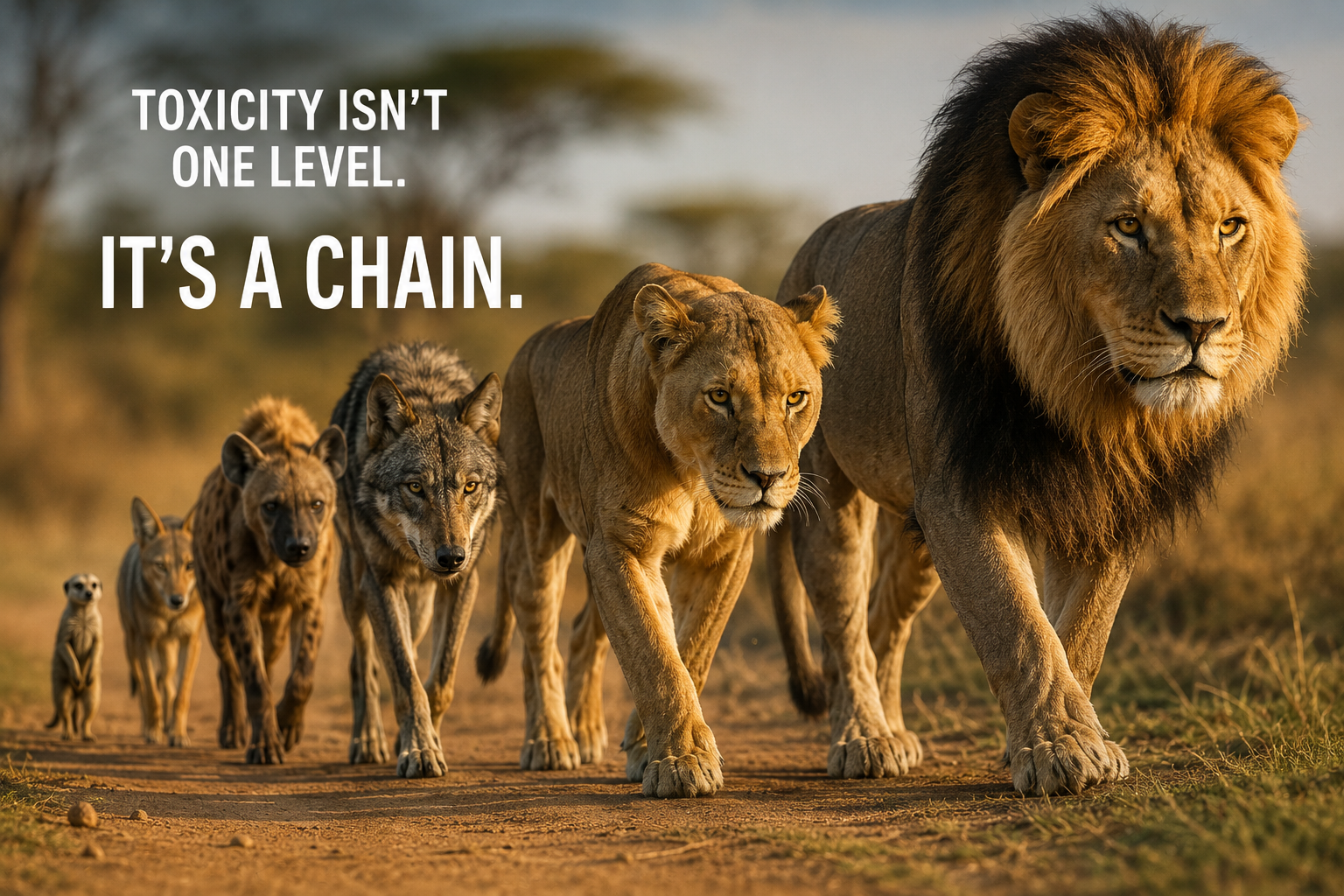
FOMO, fear of missing out, usually gets filed under social media and dating apps.
Right now, we have an unusually high number of active job seekers at C-level, VP, Director, and Management level. I'd been sharing interview details with our Life Sciences & Healthcare team — case after case, pattern after pattern — when our team supervisor said one word: FOMO. That's where it clicked. I made the connection to something else these candidates kept describing: toxic environments they couldn't quite explain why they'd stayed in.
Was it deliberate, on the company's side? Worth checking. Worth writing down.
There's more than gut feeling behind this. A widely cited study in organizational research, Mawritz and colleagues, 2012, Personnel Psychology, measured this exact pattern across three hierarchical levels: managers, supervisors, employees. Finding: difficult leadership behavior at the top level predicted difficult leadership behavior at the middle level, which in turn tracked with more misconduct inside the teams below it. A cascade effect, running through the chain of command. Later studies replicated and extended it — a 2021 study on bank branches, and a separate 2012 paper tracing the same cascade down to individual team members' creativity.
The core finding: difficult leadership behavior doesn't just get passed down like an order. It gets relearned, re-justified, re-applied at every level — by people under pressure themselves, who absorb it as "how things work here." That's the gap where FOMO comes in for me. Not why the behavior cascades. Why people at every level keep playing along instead of breaking the pattern.
And here's what's changed the equation. Several of these studies, including work done during and after COVID-19, point to the same thing: economic uncertainty and crisis conditions intensify the effect. Under stress, abusive supervision does more damage, and it spreads more easily. Job insecurity research shows the same logic from the other direction — when people are afraid for their position, they tolerate more, report less, and stay longer in conditions they'd otherwise leave.
Why now
We're not living through one crisis right now. We're living through several at once, stacked. Cost pressure, restructuring, M&A, AI-driven headcount anxiety, geopolitical noise. Multi-crisis isn't a mood; it's an operating environment. And that environment is exactly the condition under which the cascade gets worse, and FOMO gets stronger, because the cost of speaking up or walking away feels higher than it did five years ago. That combination — not either factor alone — is the reason this is worth naming now.
The chain
Holding at the top. Subsidiary underneath. And inside the subsidiary, another cascade entirely: C-level, Director, Management, Leader, Senior, employee level.
When people talk about toxic work conditions, most default to one level. The boss. The team. Maybe the culture, in the abstract. What gets lost: toxicity is rarely a point. It's a chain. And on every rung of that chain, FOMO shows up wearing a different costume.
The C-level of the subsidiary doesn't want to stand out to the holding. Not with problems, not with turnover, not with a culture that looks bad in the next quarterly review. So things get smoothed over. The fear here: missing out on the next reorg, the next capital allocation, the goodwill from above. Stay quiet, stay in the game.
One level down, Director and Management: FOMO pointed at the C-level itself. The fear of forfeiting one's own succession chances by naming a problem too loudly. So what gets reported upward is what the top wants to hear. And what gets passed downward creates calm, not clarity.
Leader and Senior level: this is where the compression meets the people with the least visibility into the bigger picture, but who feel the consequences most directly. Their FOMO is more concrete. The promotion that's supposedly coming. Internal reputation. The signal of being a "culture carrier" in an environment that's actually unwell.
Employee level: last in the chain, rarely the origin of the problem, but the one carrying it most immediately. Here FOMO often shows up as a plain fear of looking replaceable — precisely because nobody further up is taking responsibility for the conditions people are working under.
Nobody sees the whole thing
The interesting part: every level blames the one below it. The holding sees "weak leadership" in the subsidiary. The C-level sees "lack of engagement" in middle management. Management sees "lack of resilience" among employees. Nobody sees the chain as a whole — because every level is too busy protecting its own position in the hierarchy to look at it.
That's exactly what makes toxic structures so resilient. They don't need malicious leadership at the top. It just takes every level's fear of missing out being bigger than its courage to name what's happening. Then the system reinforces itself — without anyone having to act toxic on purpose.
In my own work I usually see this only in the interview room. Candidates from the second or third leadership tier who can diagnose their own organization with striking precision — but only once they're already halfway out the door. Inside the structure, the diagnosis was too risky to say out loud.
The question worth asking at every level, before pointing further down: what would I actually lose by raising this a level up, instead of passing it a level down?
Curious where you've seen this — which level, in your experience, breaks the chain?
Who's behind the Blog


Recommended Reading
- Toxic Isn't One Level. It's a Chain — and FOMO Holds It Together.
- Pool or Open Water? What Leadership Really Needs Today
- Best practice: skills-based recruiting rethought
- Skills-based recruiting: a revolution in recruiting?
- Have you ever tried a personalised wellness journal?
- Baby Boomers vs. AI: Advantages and Challenges for the Elderly Workforce
- Time to get your own Artificial Resources Manager!
- Does AI Need a C-Level Position in Companies?
- Embracing the Future or Dance with the Devil? The Role of AI in Human Resources
- Embracing Experience: The Benefits and Challenges of Older Employees
- The dilemma to change for the better: Why companies hesitate to hire new executive search firms
- Navigating International Searches: The Significance of Cultural Fit
- Money, money, money – why don’t we just pay people more?!
- What comes after the great resignation? A service-free-zone?
- Is digital leadership a skillset or a mindset?
- “What are your salary expectations?” – and the answer
- Fishing in international waters? Collaboration in executive search
- Outplacement from a company’s point of view
Search by tag